Italy - 4
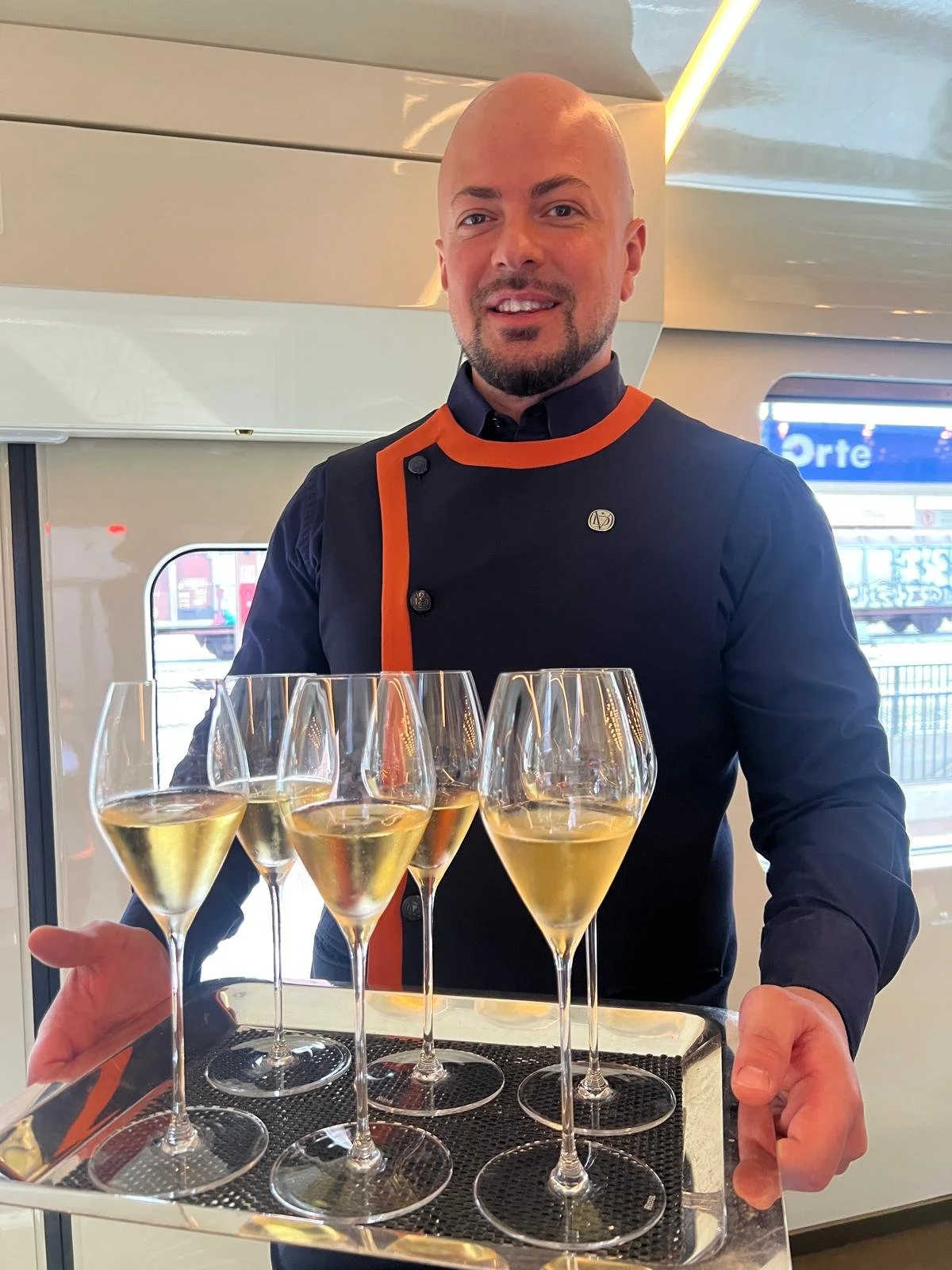
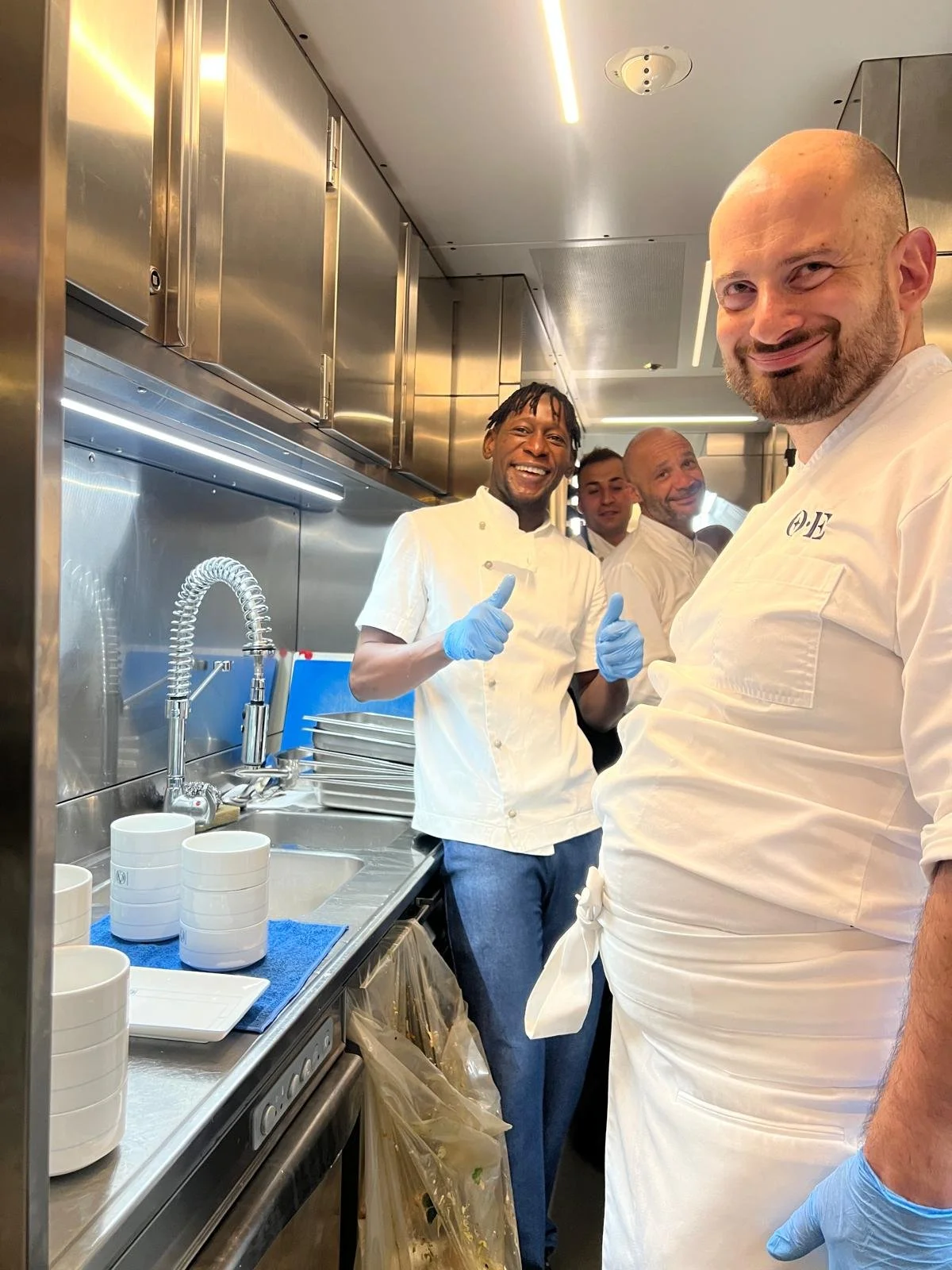
All 23 onboard guys and girls on Dolce Vita Orient Express look chic, in oatmeal or navy apparel that oozes Italian-ness. They sure seem to work non-stop, 24/7, duration of a journey (they report for duty three hours before departure, and when it’s all over, and the incessant photo-taking guests have exhausted both selves and selfies the team hangs around to do whatever’s necessary and goes off-duty, sometimes for ten days). Three on. Ten off. They need that time off: working in the kitchen is especially demanding, to say the least – see below.
In between journeys, the train is completely cleaned by an outsourced company. The train is absolutely spotlessly gorgeous. The interiors have been done by Dimore Studio, led by two guys, Britt Moran, from South Carolina, and an Italian, Emilio Salci. What Dimore’s done for train is best described as mid-century Italian glamour. Girlahead absolutely adored the glorious peach-coloured suede corridors - as the train rocks from side to side, you're protected from being bumped. The suede acts as gallery for historic black and white Dolce Vita photos taken by Marcello Cipessi.
Even with 48 hours aboard there just isn’t enough time to absorb the significance of Dolce Vita Orient Express, based at Rome's Ostiense station, where it has its own dedicated passenger lounge that’s a reminder of the lobby of The Savoy in London, although that doesn’t have either a grand piano or a full stocked-and-complimentary bar. Arsenale visionary Paolo Barletta, undoubtedly egged on by his pal Nicola Bulgari, had the idea for this-all, and the train runs in partnership with Accor, and increasingly with waiting-in-the-wings LVMH, and, for tracks and hardware, with Italy's national rail company, Ferrovie dello Stato Italiano, The history of it all goes back to the original Orient Express created by George Nackelmakers in 1883. to run between Paris and Constantinople.
This train, today, has 12 sets of rolling stock dating back to the 1960s, all with completely re-built tops, called cars rather than carriages. Seven guest cars are either divided into six or four suites - the difference is obviously not the width, but the length: the premium cars, the ones that occupy a quarter of an entire car, have space for full-time, full-length beds. The smaller suites, in cars divided into six, have sofa beds which are made up into very comfortable beds at night.
Suite E1, at the far end of six-suite car E, was extremely pleasant for one person, with just enough space for the agile but it could be compact for a pair of sumos. It's more or less square, about 2.25 meters each side. Sit on the daybed sofa. The full-size spotless window on the left gives perfect views of the countryside. There's a writing desk, which obviously collapses at night: it has a tan leather surface, matching the tan leather of the tissue box. The wall ahead is in nearly entirely mirrored. Two mirrored doors open to the bathroom, another two doors reveal the closet. Part of the right wall, all suede, is duck egg blue, with a dark chocolate base. The wall behind is entirely mirrored. The sides of the bed, there are European sockets with one each USB and USC. The ceiling has rounded edges. There is a traditional railway rack over the window, probably best for basketball players
The bathroom is ingeniously compact (the hanging waffle robe takes up a extraordinary lot of space). The shower is clever - its two glass doors are held with a clip across. Controls are very easy and toiletries are freestanding Eredi Zucca Milano pump-pots, their exterior decoration in what one could describe as exaggeratedly Medici: the mega shower has two heads. There's a dinky washbasin, black marble base, and the push-button toilet is diagonally set and offers a satisfactory and must-be-won ergonomic challenge. The closet just has space for four very thick, unnecessarily thick, and wide, blue hangers with velvet ends to stop clothes falling off. There's a normal safe above and white-edged navy Ottoman slippers below.
To be honest, nothing is superfluous, except perhaps a tan chair, circular seating with 180° of vertical metal support rods above. Everything that can be is mirrored. High non-mirrored features are colours and the ceiling. The colour palette is deep chocolate up to a height of 80 centimetres, and then duck egg blue up to two metres, after which this gorgeous curved wood takes over. It's very well thought out, as if by a yacht specialist….